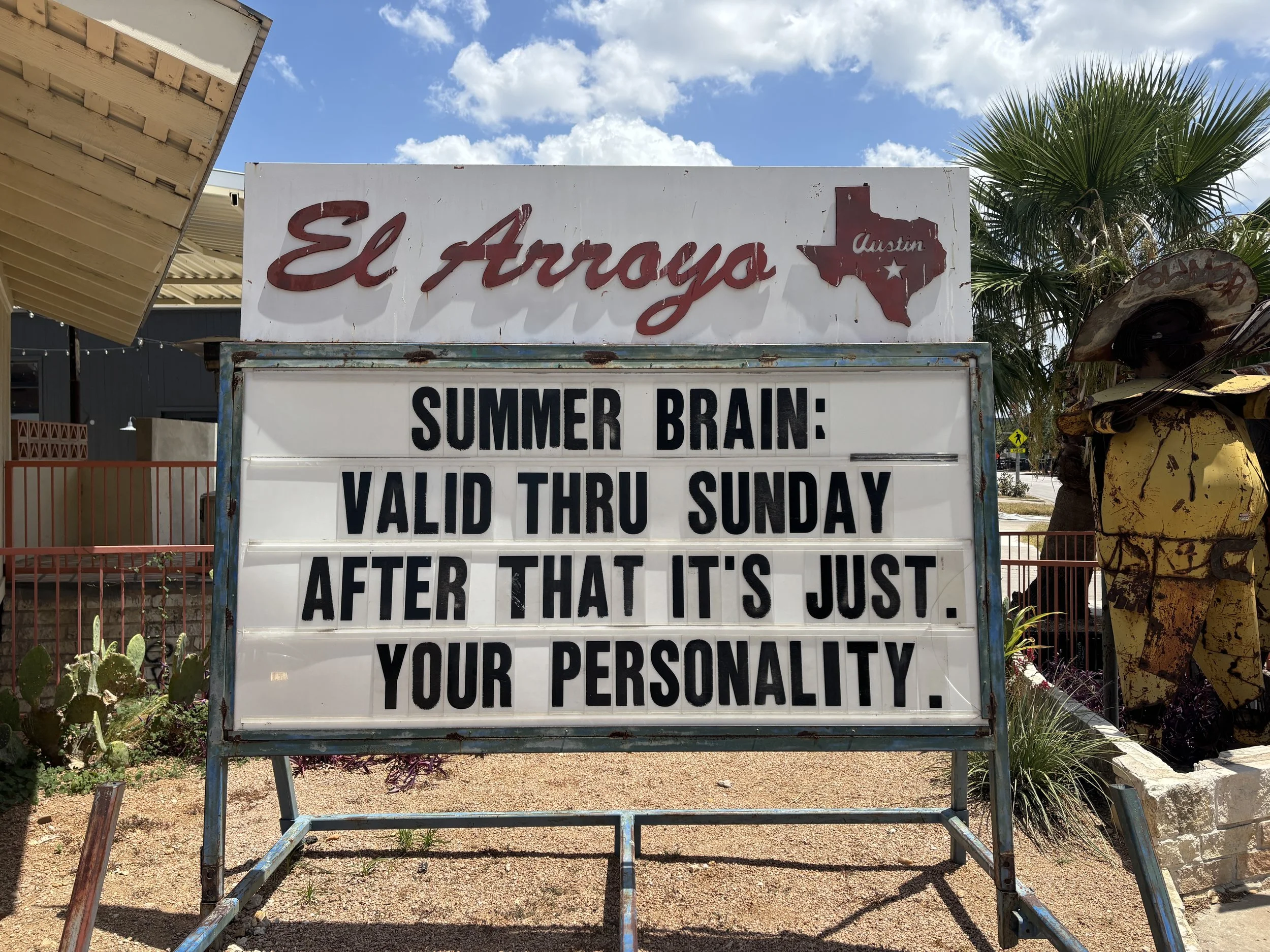
AUSTIN — The sign in front of Austin’s iconic Tex-Mex restaurant El Arroyo has drawn national attention, with fans checking in daily to see what new punchline the restaurant has come up with. For the sign’s founder, though, keeping the laughs coming can be a daily challenge, he said Aug. 5.
Twenty-one years after the sign went up outside El Arroyo on 5th Street, city officials told the restaurant’s former owner and founder of the famous marquee sign, Clay McPhail, that his sign violated a city ordinance because it changed daily. Officials told him changeable marquee signs have historically not been approved for commercial use, and that his would need to be taken down, he said.
When he heard the sign was in jeopardy, McPhail said, then-Gov. Rick Perry called him directly. “(Perry) said, ‘I’ll just pass a law that says any sign that’s been around anywhere in the state for 20 years is grandfathered.’ And I said, ‘This is how the law should be,’” McPhail said.
McPhail spoke to the Metropolitan Breakfast Club at Chez Zee American Bistro as part of the group’s weekly speaker series, reflecting on nearly 40 years in the restaurant industry. He spoke largely about the popular El Arroyo sign, known in Austin and across the country for its witty, timely short phrases.
In 1987, McPhail and his El Arroyo business partner Doug English purchased the restaurant from Bob and Mary Ogden. Before re-opening, they found the sign and its letters in a pile of trash on the property behind the restaurant. The Ogdens did not use the sign for El Arroyo — finding it was pure coincidence. It didn’t fit in the trash, McPhail said, so they put it out front instead.
“Every night we came up with another sign,” McPhail said. “It doesn’t sound too hard, but if you’re going to be interesting and funny, it’s unbelievable to change something (over) 9,000 times.”
The first sign read, “Warning: All traffic must exit — entering Tex Mex zone.” The sign drew such a strong reaction from passing drivers that police asked him to change it, McPhail said. From then on, they changed it every day.
He sold El Arroyo to Ellis and Paige Winstanley in 2012, then the rights to the sign itself in 2022. The Winstanleys still change the sign daily, and McPhail said Paige Winstanley has done a “brilliant job” of marketing the sign and building out its merchandise line. Now, El Arroyo products feature the iconic sign on tea towels, Christmas ornaments, multiple volumes of coffee table books and more.
“My daughter lives in Washington, D.C., and both bookstores by her condo have El Arroyo stuff. I get pictures from Maui and from different places (of El Arroyo merchandise),” he said.
After he sold El Arroyo, McPhail opened 5280 Burger Bar in Denver in 2014. He said he stood at the door of 5280 for six weeks, making sure someone else took his place when he couldn’t — he “wanted to know exactly where people were coming from.”
Through that, McPhail said he learned that 5280's customer base is 70% regulars.
“The true great restaurants are where people go, and they want to go back,” McPhail said.
Metropolitan Breakfast Club member B.J. Bludau said she knew McPhail personally, but learned during the talk that he is “really concerned with offering a good meal and good service, and learning who his clients are.” She also said the 70% return customer rate “says a lot about a business.”
The Metropolitan Breakfast Club began as a networking group but has grown into something deeper, President Kevin McLaughlin said. Meetings officially start at 6:45 a.m., though members often arrive early just to talk.
“You almost wish you could record the conversations beforehand. … It’s really interesting people interested in (conversing with) each other,” McLaughlin said.
Beverly Biehl, a club member and feng shui coach, said she was struck by the sign’s humble origins. “ I think the thing that struck me the most was the fact that such an iconic piece — not just of the restaurant, but of Austin — started out as something in the garbage,” she said.
“(McPhail) himself made me excited about how restaurants are adapting and how they try to find ways to bring people in, and he made it so that the focus is not about just churning people through; it’s about building community. I think the best restaurants — the long-lasting ones — are the ones that become a fixture in the community,” Biehl said.
For McPhail, that fixture was never the plan — just a byproduct of showing up every day for 25 years.
“We started El Arroyo (in 1987), and this is how it’s evolved. It took a lot of love. I didn’t plan for this thing to be worldwide. I had no idea. But I loved what I did,” McPhail said.
McLaughlin said McPhail seems aware of the effect the sign has on Austin's culture and leans into it. He said the Metropolitan Breakfast Club was excited to hear from the founder of such a recognizable piece of the Austin experience.
“Everybody’s got their own sign story, and he got to put them all together,” McLaughlin said.
